

Empire Crypto: Complete Guide to Cryptocurrency Risks
Navigating digital assets without reliable crypto data is like sailing into a storm blindfolded. While blockchain financial markets offer unprecedented wealth opportunities, navigating them requires a crystal-clear understanding of underlying market dynamics. Every transaction, smart contract interaction, and token purchase carries hidden exposure points. To build a lasting portfolio, every investor must master the fundamentals of crypto market data. At Empire Crypto, we equip investors with high-grade cryptocurrency data analytics so you can spot systemic dangers long before they hit your balance sheet.

Why Crypto Data Analysis is Essential for Risk Management
Traditional financial markets rely on centralized clearing houses and regulated reporting structures. Crypto, however, runs on decentralized ledgers that generate gigabytes of raw, unstructured data every second. Without continuous trading data analysis cryptocurrency monitoring, investors easily fall victim to unexpected market crashes, liquidity drains, or protocol exploits.
Accessing reliable best crypto data transforms abstract market chaos into actionable insights. By leveraging the specialized crypto data solutions developed by Empire Crypto, you can monitor capital flows, measure market sentiment, and protect your digital assets across multiple blockchains.
Core Categories of Cryptocurrency Risks
Evaluating digital asset hazards requires breaking them down into quantifiable vectors. Accurate cryptocurrency data analysis shows that asset losses typically fall into five distinct operational buckets.
1. Market Volatility and Price Shock Risks
Crypto markets run 24/7 without circuit breakers. Sharp drops occur within minutes due to sudden leverage liquidations, macroeconomic shifts, or large whale sell-offs.
- Volatile Cycles: High-beta altcoins often drop 80% to 90% during broader market corrections.
- Leverage Cascades: Derivatives platforms trigger automated liquidations that accelerate price drops.
2. Liquidity and Slippage Hazards
Having a high portfolio balance on paper means nothing if market depth is too shallow to handle your sell orders.
- Low Liquidity Trap: Smaller market cap tokens suffer extreme price slippage during exits.
- Fake Exchange Volume: Fraudulent venues inflate volume numbers through wash trading to deceive retail traders.
3. Security and Smart Contract Vulnerabilities
Decentralized applications (dApps) rely on smart contract code. If that code contains a flaw, malicious actors can drain decentralized pools instantaneously.
- Reentrancy Exploits: Hackers trick protocols into sending funds repeatedly before balance updates register.
- Private Key Theft: Poor personal storage leads to unauthorized wallet access.
4. Regulatory, Compliance, and Legal Risks
Governments around the world continually update legal frameworks around token registrations, stablecoins, and tax compliance.
- Jurisdiction Enforcement: Delistings on centralized exchanges frequently cause steep, immediate asset price drops.
- Sanctions Exposure: On-chain interactions with sanctioned pool addresses can black-list your wallet.
5. Tokenomics and Systemic Structural Faults
Poorly designed token supply structures dilute investor value over time.
- Aggressive Unlocks: Large early-investor token unlocks create persistent selling pressure.
- Hyper-Inflationary Emission Rates: Tokens with uncapped minting schedules systematically bleed value against major assets.
How to Use Crypto Data to Detect Risks Early
Beginner Risk Indicators: Essential Metrics to Track
If you are new to market analytics, start by tracking these three fundamental metrics to protect your capital:
- 24-Hour Trading Volume vs. Market Cap: Ensure daily volume is proportionate to overall valuation. Low volume relative to market cap signals poor asset liquidity.
- Circulating vs. Total Supply Ratio: High discrepancies between circulating and total supply mean heavy future token emissions will dilute existing token holders.
- Exchange Inflow/Outflow Data: Massive token inflows into centralized exchanges signal impending sell-offs, whereas net platform outflows indicate accumulation.
Advanced Risk Analytics for Experienced Investors
Intermediate and institutional investors use deeper Empire Crypto analytics metrics to evaluate underlying protocol health:
| Metric Name | What It Measures | Target Risk Signal |
| NVT Ratio (Network Value to Transactions) | Evaluates market cap against transaction throughput | High values suggest an overvalued asset ripe for a correction. |
| MVRV Z-Score | Measures market value relative to realized historical value | Extreme highs mark cycle tops; extreme lows point to market bottoms. |
| Whale Concentration Index | Percentage of total token supply held by top 100 wallets | Concentrations above 60% create high risk of price manipulation. |
| Smart Contract Health Score | Analyzes code audit status and developer GitHub activity | Infrequent code updates indicate stagnant or abandoned development. |
Real-World Case Studies: When Data Saved Investors
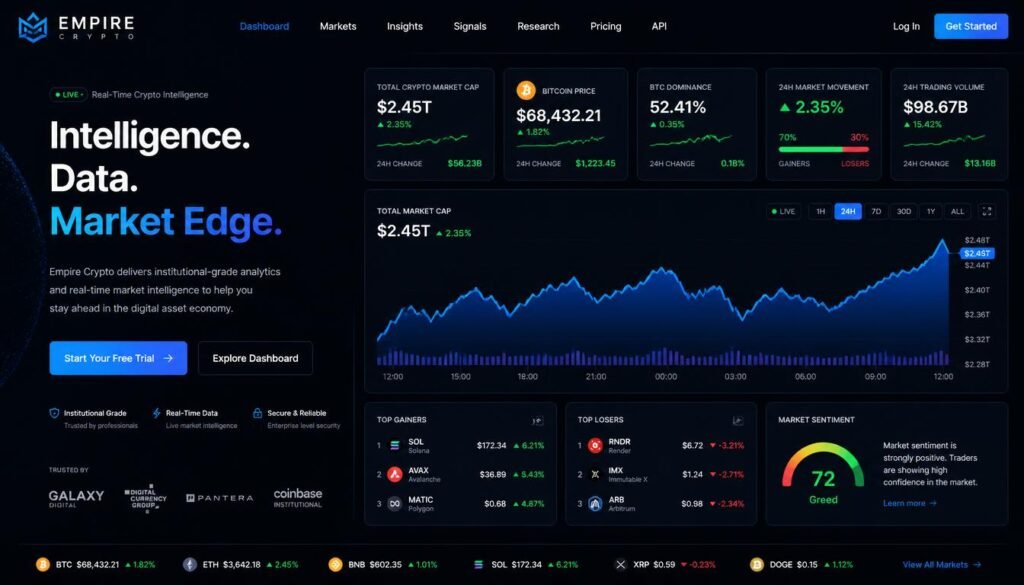
Case Study 1: Spotting the De-Peg Threat
During historical algorithmic stablecoin failures, on-chain liquidity data showed massive capital flight hours before public panics hit major news outlets. Traders analyzing real-time decentralized reserve pool imbalances using Empire Crypto platforms pulled capital safely before major de-pegging events caused widespread insolvency.
Case Study 2: Identifying Token Dump Schedules
In late 2024, a trending DeFi asset surged 300% in weeks. However, Empire Crypto data tools flagged an upcoming venture capital token unlock equal to 40% of the circulating supply. Informed users sold positions ahead of the release date, completely avoiding the subsequent 65% market drop.
About Empire Crypto Data
Empire Crypto is a premier crypto data company dedicated to delivering pristine, real-time analytics for digital asset investors. We turn raw on-chain records, order book depth, and protocol code metrics into actionable risk management insights.
Why Trust Empire Crypto Data Solutions?
- Institutional Cryptocurrency Data Reliability: Verified data cleaning routines filter out wash trading and phantom volume.
- Comprehensive Market Coverage: Tracking thousands of spot markets, decentralized liquidity pairs, and smart contract networks in real time.
- Predictive Alert Engine: Receive automated notifications when smart contract anomaly flags, whale wallet transfers, or sudden liquidity drains occur.
By integrating Empire Crypto tools into your regular analysis, you shift from reactive gambling to data-backed investing.
Step-by-Step Guide to Auditing a Crypto Asset with Empire Crypto
- Check Contract & Audit Data: Verify that the project’s smart contracts are fully audited by top-tier security firms and that no critical vulnerabilities remain unaddressed.
- Analyze Wallet Concentration: Ensure top non-exchange wallets do not control a dangerous share of the total supply.
- Review Token Unlock Calendars: Check upcoming linear and cliff token releases to avoid buying right before big supply increases.
- Evaluate Market Liquidity Depth: Inspect the order books across major platforms to confirm you can enter and exit positions with minimal price impact.
- Monitor Developer Activity: Verify that code repositories show continuous, organic contributions rather than inactive or duplicated codebases.
Frequently Asked Questions (FAQ)
Q1: What is the single biggest risk when investing in cryptocurrency?
The biggest danger for retail investors is a combination of sudden market volatility and unvetted smart contract security vulnerabilities. Without using a dedicated crypto data solution to verify token mechanics, investors risk total capital loss from protocol exploits or sudden illiquidity.
Q2: How can I verify cryptocurrency data reliability before trading?
Cross-reference multi-source market data across centralized platforms and on-chain block explorers. Premium platforms like Empire Crypto automatically run verification algorithms to filter out fake exchange volumes and market manipulation schemes.
Q3: Is market cap alone a reliable metric for asset risk?
No. Market cap only reflects current price multiplied by circulating supply. It ignores upcoming supply unlocks, order book liquidity, and real on-chain user activity. Always combine market cap with deeper Empire Crypto analytics metrics like the NVT ratio and liquidity depth charts.
Q4: How does Empire Crypto help reduce smart contract risk?
Empire Crypto scans protocol smart contract addresses for security vulnerabilities, tracks developer code commits, and flags unusual admin wallet interactions in real time.
Conclusion: Build a Data-Driven Crypto Strategy Today
Navigating cryptocurrency risks doesn’t mean avoiding digital assets entirely—it means replacing blind speculation with disciplined, data-driven strategy. By tracking key on-chain metrics, analyzing token distribution schedules, and monitoring market depth, you protect your portfolio against sudden drawdowns and protocol failures.
Ready to elevate your trading precision and secure your digital assets? Experience the market clarity powered by Empire Crypto. Gain instant access to institutional-grade analytics, track real-time risk scores, and make every trade with complete confidence.
About The Author
