

The Tech Times: Public Administration Guide — 2026
Here at The Tech Times, we believe that understanding this machine is the first step toward making it work better. As a modern technology information source, The Tech Times keeps a close eye on how digital tools, policy, and human organization collide. That is why we have put together this definitive public administration guide. Whether you are preparing for university exams, shifting your career, or simply trying to make sense of how state agencies run, this public administration guide will serve as your ultimate navigation tool.
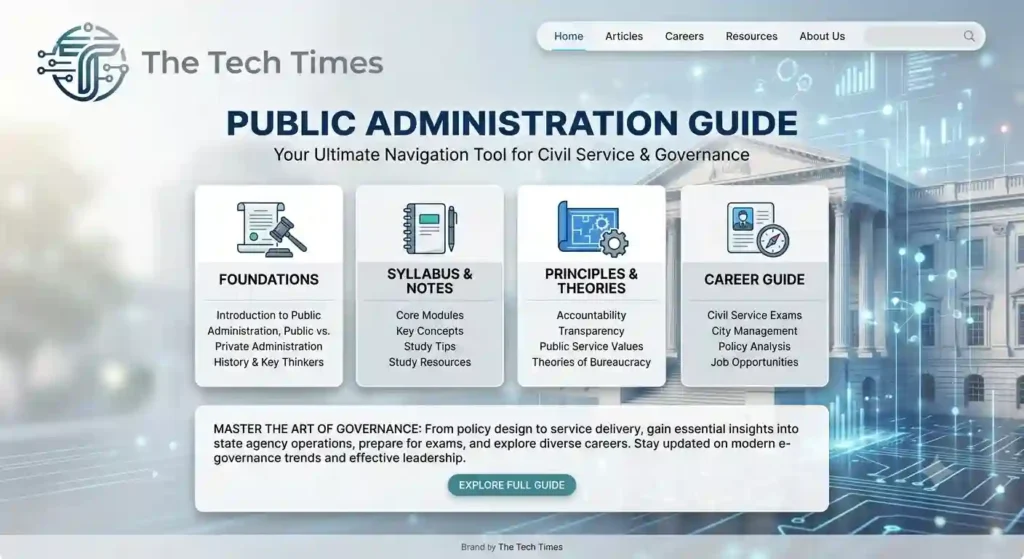
Introduction to Public Administration
To understand how societies function, we must begin with a comprehensive introduction to public administration. Put simply, if politics is about deciding who gets what, when, and how, then public administration is the actual process of delivering those resources. It is the practical arm of government, responsible for turning legislative ideas into real-world programs.
Historically, this field focused on managing paperwork, enforcing strict local laws, and maintaining public infrastructure. But as The Tech Times frequently observes, the modern era has completely rewritten this playbook. Today, an effective introduction to public administration must address the digital reality: cloud computing, automated benefit systems, data privacy, and online civic platforms.
For students and professionals alike, grasping these concepts is vital. If you are preparing to study this discipline, having a structured public administration study guide can save you countless hours of confusion. The system can feel overwhelming at first, but once you understand the basic mechanics, the pieces of the puzzle fall into place.
What is Public Administration?
At its core, this discipline is both an academic field of study and an active profession. It is focused on how public organizations are structured, how they manage resources, and how they deliver services to citizens.
To grasp the public administration basics, it is helpful to look at how this field compares to the private sector. While a corporate manager focuses on driving profit and satisfying private shareholders, a public manager must prioritize equity, constitutional law, and the public interest.
Public vs. Private Administration: Key Differences
| Feature | Public Administration | Private Administration |
| Primary Metric of Success | Public welfare, social equity, and program effectiveness | Net profit, market share, and investment returns |
| Funding Source | Public tax revenues, government bonds, and grants | Venture capital, customer sales, and private loans |
| Legal Framework | Bound by strict administrative laws and public transparency | Governed by general business laws and corporate bylaws |
| Accountability | To elected officials, oversight bodies, and the public | To board members, owners, and private shareholders |
When you start drafting your public administration notes, keep these distinctions at the top of your page. Understanding these differences will help you make sense of why government agencies sometimes seem to move slower than tech startups. It isn’t necessarily due to laziness; rather, it is because public entities are legally required to be transparent, fair, and accountable to everyone, not just a select group of customers. This core tension is a foundational theme in almost every introduction to public administration.
Why Public Administration Matters Today
As a platform providing insights, guides, and updates, The Tech Times has documented how global crises put public institutions to the test. When a public health emergency hits, or when a major climate event threatens power grids, we rely entirely on the competence of public administrators.
                    ┌────────────────────────┐
                    │  Effective Governance  │
                    └───────────┬────────────┘
                                │
         ┌──────────────────────┼──────────────────────┐
         ▼                      ▼                      ▼
┌─────────────────┐    ┌─────────────────┐    ┌─────────────────┐
│     Crisis      │    │     Digital     │    │  Social Equity  │
│   Management    │    │  Modernization  │    │  & Fair Access  │
└─────────────────┘    └─────────────────┘    └─────────────────┘
Here is why mastering the public administration basics is so important today:
- Handling Complex Crises: Modern challenges like pandemics, economic shifts, and climate change do not respect geographic borders. They require coordinated, multi-agency responses.
- Executing Digital Transformation: Citizens expect government services to be as fast and easy to use as their favorite mobile apps. Modern administrators must know how to lead digital upgrades without leaving vulnerable populations behind.
- Protecting Public Trust: In an era of political polarization, professional, non-partisan administration keeps society stable. It ensures that essential services remain reliable, no matter who wins the latest election.
Key Features and Benefits of Modern Governance
When built on strong public administration principles, a healthy bureaucracy provides several major benefits to a country. Let’s look at the key features that make this system work.
1. Permanent Administrative Structure
While political leaders come and go with election cycles, the civil service provides continuity. The technical staff, policy experts, and operational managers remain in place to ensure that basic public services are never interrupted.
2. Standardized Rules and Fairness
A primary benefit of a rules-based administration is consistency. By applying the same regulations to everyone, public organizations protect citizens from corruption, favoritism, and arbitrary decisions.
3. Professional Meritocracy
Modern systems rely on hiring and promoting staff based on their skills and qualifications rather than political connections. This professional focus is a key concept in any standard public administration study guide.
How Public Administration Works on the Ground
To understand how public policies actually get implemented, we have to look at the classic management functions. Traditionally, scholars used the acronym POSDCORB to describe the workflow of a manager:
- Planning: Outlining what needs to be done and how to do it.
- Organizing: Setting up the formal structure of authority and departments.
- Staffing: Hiring, training, and maintaining a positive work environment.
- Directing: Making decisions and issuing instructions to guide the team.
- Coordinating: Connecting different parts of the organization to work together.
- Reporting: Keeping leadership and the public informed about progress.
- Budgeting: Managing finances, auditing expenditures, and planning taxes.
While POSDCORB is still a staple of introductory public administration notes, modern governance has evolved. Today, public administrators spend less time managing rigid hierarchies and more time managing complex networks. They coordinate with non-profit organizations, private contractors, and community groups to get things done.
At The Tech Times, we often highlight how modern city governments use these collaborative networks to build smart infrastructure. By combining the stability of public oversight with the speed of private innovation, governments can deliver much better results for their residents.
The Academic Journey: Syllabus, Books, and Study Tips
If you want to master this field, you need a clear learning plan. Whether you are studying independently or enrolling in an academic program, organizing your approach around a formal public administration syllabus is incredibly helpful.
Typical Public Administration Syllabus Modules
A standard curriculum is usually split into several key areas:
- Foundational Stage: An introduction to public administration, exploring history, basic definitions, and the evolution of the modern state.
- Theoretical Stage: Deep dives into classic public administration theories and how they apply to organizational behavior.
- Management & Policy Stage: Focus on budget design, personnel management, policy evaluation, and administrative law.
- Modern Challenges Stage: Digital governance, public-private partnerships, crisis management, and professional ethics.
To help you navigate these academic topics, The Tech Times recommends building a highly structured public administration study guide that synthesizes your reading notes with real-world news stories.
Indispensable Public Administration Books
Every serious student should have these essential public administration books on their shelf:
- “Introducing Public Administration” by Jay M. Shafritz, Albert C. Hyde, and Sandra J. Parkes. This is arguably the most popular textbook for getting a solid handle on the public administration basics.
- “Classics of Public Administration” by Jay M. Shafritz and Albert C. Hyde. A fantastic collection of historical essays, tracking how the field has changed over the last century.
- “The Bureaucratic Phenomenon” by Michel Crozier. A classic analysis of how large organizations behave and why they sometimes resist change.
- “Public Administration: Understanding Management, Politics, and Law in the Public Sector” by David H. Rosenbloom. This book offers a brilliant look at how political, legal, and managerial values compete within public agencies.
As you read these public administration books, try to summarize each chapter into quick, actionable takeaways. Keeping these active summaries in your public administration notes will make it much easier to study for exams or prepare for job interviews.
Core Theories and Principles of Governance
To truly understand how public systems work, we have to look at the ideas that shaped them. The field is built on a rich history of public administration theories and public administration principles that explain how humans work together at scale.
+-----------------------------------------------------------------------------+
|                     Evolution of Administrative Thought                     |
+-----------------------------------------------------------------------------+
| 1. Classical Bureaucracy (Weber) -> Focus on rules, hierarchy, and merit    |
| 2. Politics-Administration Dichotomy (Wilson) -> Separate politics from run |
| 3. Human Relations (Mayo) -> Focus on employee motivation and social groups |
| 4. New Public Management (NPM) -> Bring private sector efficiency to state  |
| 5. New Public Governance (NPG) -> Focus on networks and citizen co-creation |
+-----------------------------------------------------------------------------+
Essential Theories You Need to Know
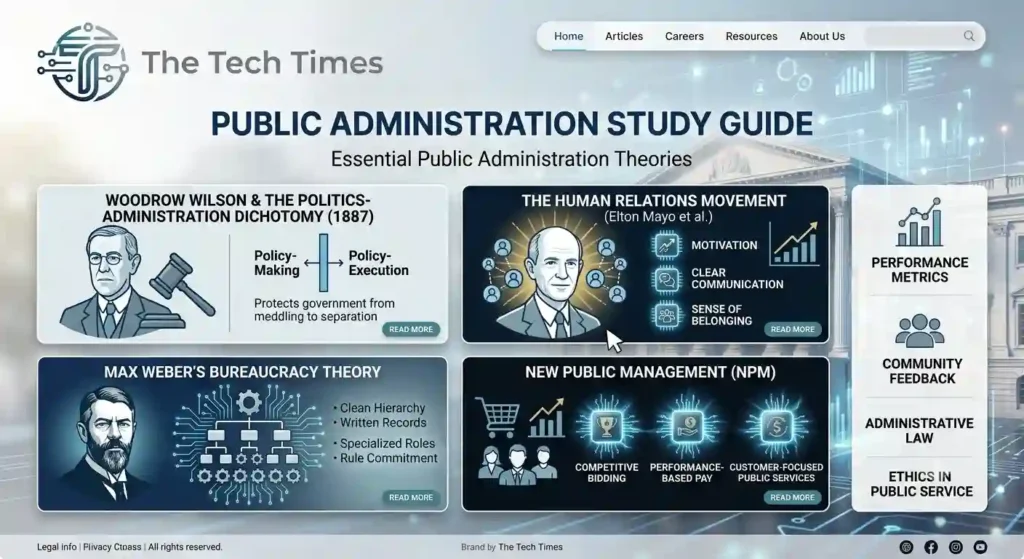
Woodrow Wilson and the Politics-Administration Dichotomy
In his famous 1887 essay, Wilson argued that policy-making (politics) and policy-execution (administration) should be kept completely separate. The goal was to protect the day-to-day operations of government from political meddling and corruption. While this complete separation is hard to maintain in the real world, it remains an important concept in any introduction to public administration.
Max Weber’s Bureaucracy Theory
Weber described the “ideal type” of bureaucracy as a highly structured, rational organization. It relies on a clear hierarchy, written records, specialized roles, and a strict commitment to rules. While “bureaucracy” is often used as a negative word today, Weber saw it as the most efficient and fair way to organize large numbers of people.
The Human Relations Movement
In the mid-20th century, researchers like Elton Mayo showed that employees aren’t just cogs in a machine. They are human beings who need motivation, clear communication, and a sense of belonging. This shift heavily influenced modern public administration principles, highlighting that managing people well is just as important as setting strict rules.
New Public Management (NPM)
Popularized in the 1980s and 1990s, NPM argued that governments should run more like private businesses. This theory introduced competitive bidding, performance-based pay, and customer-focused public services. It is a major topic in any advanced public administration syllabus.
Important Factors to Consider in Public Leadership
If you plan to work in this field, theoretical knowledge isn’t enough. You must learn to navigate several practical factors that influence daily operations:
- Budget and Resource Constraints: Public agencies rarely have all the funding they want. Learning how to prioritize programs and manage tight budgets is an essential skill.
- Legal Compliance: Every decision you make must align with administrative law, constitutional protections, and local ordinances.
- Political Shifts: A change in political leadership can bring brand-new priorities, requiring administrators to adapt quickly while keeping services running smoothly.
- Community Engagement: Modern public administration requires active communication with citizens. Leaders must know how to run public forums, gather community feedback, and build trust.
Expert Tips and Best Practices
To help you excel, we asked seasoned professionals from our network at The Tech Times for their top practical tips. Here are their best practices for modern administrators:
Use Data to Drive Decisions
Don’t rely on guesswork. Use data analytics, performance metrics, and community feedback to identify where services are lagging and where resources are needed most.
Foster a Culture of Transparency
Whenever possible, share your agency’s goals, progress, and budgets with the public. Transparency builds trust and makes it much easier to get community buy-in for new projects.
Focus on Digital Accessibility
When designing online portals or digital services, ensure they are simple, mobile-friendly, and accessible to people of all abilities and backgrounds.
Invest in Continuous Learning
The tools of governance are constantly changing. Keep your skills sharp by reading the latest public administration books, attending workshops, and updating your professional credentials.
Common Pitfalls to Avoid in Public Administration
Even the most well-meaning administrators can run into common organizational traps. Here is what to watch out for:
- Falling Into Rule Obsession: It is easy to get so caught up in administrative rules that you lose sight of the actual goal: helping people. Always look for ways to simplify processes within legal boundaries.
- Working in Silos: When departments don’t talk to each other, services become fragmented and inefficient. Encourage open communication across different teams and agencies.
- Ignoring Frontline Staff: The workers who interact with the public every day usually have the best ideas for how to improve services. Make sure you are actively listening to their feedback.
- Resisting New Technology: Staying stuck in old, paper-based ways of working limits your efficiency. As The Tech Times regularly points out, embracing digital tools is key to running a modern, responsive agency.
Career Paths in Public Service
For anyone looking to make a real difference in their community, this field offers incredibly diverse and rewarding opportunities. Our public administration career guide outlines some of the most common professional paths:
City Manager / Municipal Administrator
City managers oversee the day-to-day operations of local governments. They manage city departments, draft municipal budgets, and work closely with elected city councils to implement local policies.
Public Policy Analyst
Policy analysts work for government agencies, research institutions, and advocacy groups. They collect and analyze data, evaluate the effectiveness of public programs, and write detailed policy recommendations for decision-makers.
Emergency Management Director
These professionals prepare for and coordinate responses to natural disasters, public health crises, and other emergencies. They work across different levels of government to keep communities safe.
Non-Profit Executive Director
Many graduates use their skills to lead non-profit organizations. They manage budgets, oversee community outreach programs, lead fundraising efforts, and advocate for social causes.
Government Chief Information Officer (CIO)
At the intersection of technology and governance, public-sector CIOs design and manage an agency’s digital infrastructure. They are responsible for keeping data secure, upgrading legacy systems, and rolling out new online services for citizens.
Future Trends and Next-Gen Governance
Looking ahead, the discipline is entering an exciting new phase. At The Tech Times, we are closely tracking several major trends that will shape the future of governance:
- AI-Assisted Administration: Public agencies are beginning to use artificial intelligence to automate routine tasks, analyze complex data sets, and handle simple customer service inquiries through smart chatbots.
- Decentralized Public Registries: Technologies like blockchain could soon make record-keeping—such as land registries, business licenses, and professional certifications—much more secure, fast, and transparent.
- Proactive Service Delivery: Instead of waiting for citizens to apply for benefits, future systems will use data to automatically identify and enroll eligible individuals, ensuring that support reaches those who need it most.
- Collaborative Policymaking: Online platforms will make it easier for citizens to participate directly in budgeting, urban planning, and policy design, making local government more democratic and responsive.
Frequently Asked Questions
What is the main goal of a public administration guide?
A public administration guide is designed to provide students, researchers, and professionals with a clear, practical understanding of how public organizations are run, how policies are made, and how to build a successful career in public service.
Where can I find high-quality public administration notes?
You can find comprehensive, up-to-date public administration notes right here on The Tech Times. We regularly publish detailed guides, resources, and insights focused on modern governance and digital transformation in the public sector.
What topics are typically included in a public administration syllabus?
A standard public administration syllabus covers an introduction to public administration, public policy design, administrative law, organizational behavior, government budgeting, and digital service delivery.
What are some of the most recommended public administration books?
For those looking to master the public administration basics, highly recommended texts include “Introducing Public Administration” by Shafritz, Hyde, and Parkes, and David H. Rosenbloom’s “Public Administration”.
How do core public administration principles guide civil servants?
Key public administration principles—such as accountability, transparency, integrity, and social equity—act as an ethical compass, ensuring that public managers use tax dollars responsibly and treat all citizens fairly.
Why is a public administration study guide useful for students?
An organized public administration study guide helps learners break down complex public administration theories, memorize key legal frameworks, and prepare effectively for academic or civil service exams.
What kind of jobs are detailed in a public administration career guide?
A professional public administration career guide highlights a wide range of roles, including City Manager, Policy Analyst, Budget Director, Non-Profit Executive, and public-sector Chief Information Officer (CIO).
How do public administration theories help solve real-world problems?
Classic and modern public administration theories give managers proven frameworks to diagnose organizational problems, streamline bureaucratic bottlenecks, improve employee morale, and design better public programs.
Final Thoughts
Running a modern society is a complex challenge, but understanding how it works doesn’t have to be. By exploring the history of the field, mastering key public administration principles, and diving into the core public administration theories, you can build a strong foundation in how public institutions operate.
As technology continues to change how governments interact with citizens, The Tech Times remains committed to providing you with the clear, practical insights you need to stay ahead. Whether you are using this public administration guide to study for your next exam, organize your personal public administration notes, or map out your professional future with our public administration career guide, we hope this resource has given you the confidence to take your next steps. The future of public service is bright, and it is being built by forward-thinking, dedicated people just like you. Turn to The Tech Times whenever you need updates on how technology and governance are shaping our world.
About The Author
